Tag: Brexit judgment
-

Ewan McGaughey: What Is Needed in Our Constitution to Revoke Article 50?
Professors Gavin Phillipson and Alison Young have argued on this blog that an Act of Parliament is needed to revoke article 50. An alternative view is that, while an Act may be desirable, it is not necessary. This is still an important issue because on Wednesday 27th of March 2019, 184 votes in the House…
-

Robert Craig: Can the Government Use the Royal Prerogative to Extend Article 50?
Introduction The possibility of extending the Article 50 process is being discussed in media outlets and social media. There are a number of potential scenarios where a short extension might be sought: to implement the Withdrawal Agreement in law to manage the process of a no deal Brexit to hold a general election to hold…
-

Brian Christopher Jones: Wightman and How Not to Advance the Law
Wightman v Advocate General [2018] concerns whether it is legally possible to reverse an Article 50 notice given to the European Union. At first instance the Lord Ordinary refused permission for the petition to proceed, saying that the issue was “hypothetical and academic”. Under the Court of Session Act 1988, one of the hurdles for…
-
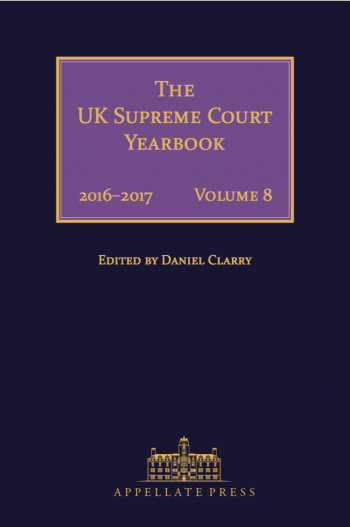
The UK Supreme Court Yearbook, Volume 8: 2016-2017 Legal Year
The UK Supreme Court Yearbook, Volume 8: 2016-2017 Legal Year The UK Supreme Court Yearbook, Volume 8 44 contributions 684 pages Hardbound Edited by Dr Daniel Clarry Published by Appellate Press Available to order online and in-store at Wildy & Sons Ltd. To view the table of contents for Volume 8, visit Wildy & Sons…
-

Christopher McCrudden and Daniel Halberstam: Northern Ireland’s Supreme Court Brexit Problem (and the UK’s too)
There are many unfortunate results of Brexit, but one of the most problematic is the adverse effects it has had on current and future relationships between Britain and Ireland, and within Northern Ireland. These adverse effects were entirely predictable and show little sign of abating, significantly contributing to the difficulties the UK government faces in…
-
Robert Craig: Why an Act of Parliament Would Be Required to Revoke Notification under Article 50
The possibility of the UK revoking its Article 50 notice is hitting the headlines. The Prime Minister was asked last Monday in Parliament if she had received legal advice that she could revoke the triggering of the Article 50 process. Her equivocal response led many to believe that such advice does indeed exist. Last Tuesday,…
-

Cormac Mac Amhlaigh: Can Brexit Be Stopped under EU Law?
Ominous clouds are gathering and the terrain underfoot increasingly resembles a quagmire on the Brexiteers’ ‘sunlit uplands’. The latest reminders that the reality will be significantly different from their utopia of a prosperous global Buccaneering Britain has come in the form of a trade dispute between the U.S. and a Canadian aircraft manufacturer which could…
-

Jean-Pierre Gauci and Robert McCorquodale: Brexit and Transitional Provisions: International Law Can Assist
In a recent statement, The Chancellor, Philip Hammond, highlighted the need for transitional measures to be agreed soon in the Brexit discussions. He is reported as stating: I am confident we can do a Brexit deal which puts jobs and prosperity first, that reassures employers that they will still be able to access the…
-

Aurelien Antoine: Brexit Seen by a French Professor in Public Law
I am a professor in Public in France devoting the major part of my research to the United Kingdom (author, among other books, of a “British constitutional Law” prefaced by Lord Mance, editions LGDJ, and director of the “Observatoire du Brexit”), I wished to submit to my British colleagues my general reflections on institutional and legal…
-

Elizabeth Campion: The Constitutional “Ripple Effect” of the European Union (Notification of Withdrawal) Act 2017
Miller and others v Secretary of State for Exiting the European Union [2017] UKSC 5 was highly anticipated as perhaps the most signficant constitutional case of this generation, stirring up such strong reactions that the judges of the Divisional Court who initially decided in favour of Ms. Miller were dubbed “Enemies of the People”. Two…