

 Digitalisation has become an inseparable aspect of delivering public services, inspiring conversations around the impacts of digitalisation on citizens and of what it means for states to transition into being e-governments. Despite these ongoing discussions a largely overlooked topic is the process by which digital public services are designed and delivered in the first place. This is surprising considering that the design process constitutes a significant area of administrative decision-making. It not only has ramifications for those relying on public services as most key decisions on the shape, scope, and substance of digital services rest within that process, but also for administration in an era of digital governance. The process by which central government designs and delivers digital public services can be used on the one hand, to uncover what internal laws of administration affect the nature of digital public services (Wyman 1904; Daintith and Page 1999) and on the other, to showcase the extent to which the government’s digital transformation is an internal cultural transformation of the public sector as much as a technological one. Acknowledging the far-reaching effects of the design process, both on what public services are delivered and on public administration, can be a stepping stone for exploring new and more targeted possibilities for reforming the digital state.
The design cycle
Created by the Government Digital Service (‘GDS’), the design cycle of a digital service is in theory quite simple. There are four design phases, each with its own unique purpose, and in-between these phases the service is subject to Service Assessments. These Assessments use the GDS Service Standard to judge whether the service can progress from one phase to the next. If for any reason services are no longer serving their purpose (e.g. outdated infrastructure, change in policy, replacement service etc.) or they cannot successfully proceed to the next design phase, they are “retired” or abandoned. The diagram below provides a simplified representation of the design flow, noting the key elements of each phase.
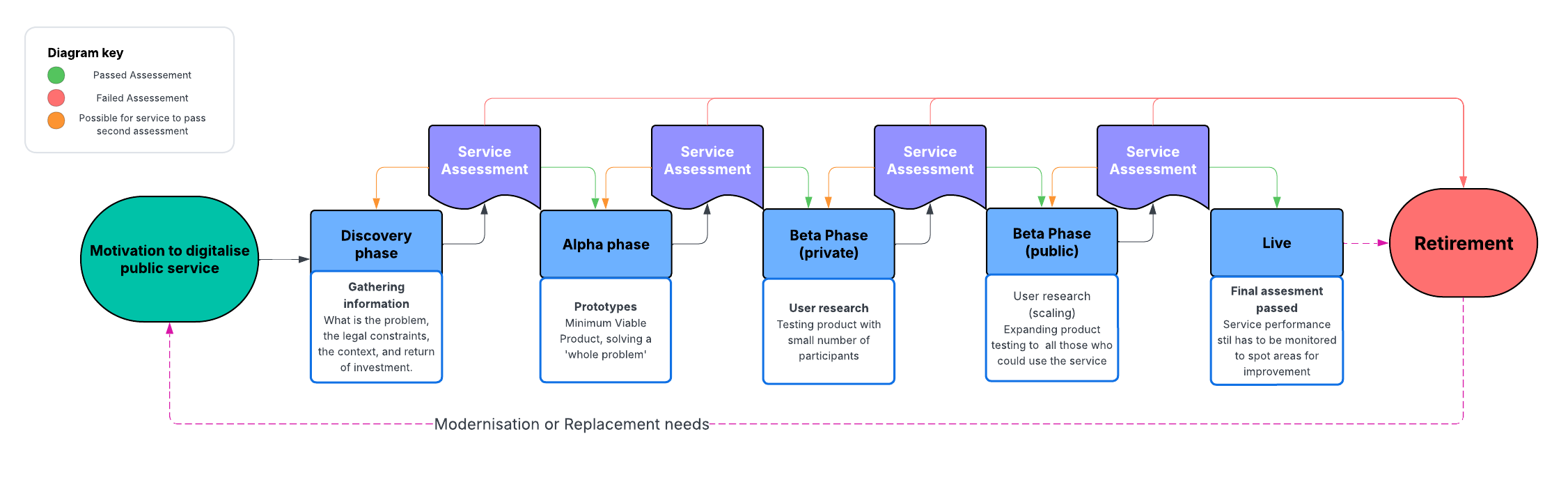
Development begins with the discovery phase, where the relevant digital team will identify a problem that could be solved through the creation of a digital service. During discovery, teams will spend time understanding the context of the problem that they are trying to solve and confirming that there are no legal issues that would prevent the service from moving forward. At its core the discovery phase initiates a fact-finding exercise that informs the service design and which in some form continues in the design phases that follow.
The next stage is the alpha phase, which is when teams will start experimenting with different prototypes for the service. The alpha phase is also when the user, already important in the discovery phase as a source of information, becomes even more central as digital teams focus on understanding the profile of those who will use their service.
While both fall under the ‘beta’ heading, there are two distinct stages in the next phase. The private beta stage is technically the first time in the design cycle that features of the service will be “tested” by users. Parts of the service become available to a small number of people who are identified as potential users of the service with the view of collecting feedback that will inform design decisions and the final form of the service. The public beta phase on the other hand is all about scaling the service, ensuring that what has been built can support all those who would need to use the service. Roll outs at that stage can be quite slow. Universal Credit, a welfare reform first introduced in a digital format in 2013, was still completing its roll out when the 2024 report on its status was released.
The live phase represents the “finalised” version of the service whereby the service has passed all relevant assessments and is fully in place to be used by any who may need it. Interestingly, there do not appear to be any significant differentiations between a service in public beta and one in the live phase other than that final assessment, and many services operate normally while in beta.
Within the design process, there are features that provide clues as to what considerations shape digital services and others that signal a wider shift in how the design and delivery of public services is governed. The focus now turns towards some of these features, specifically the central piece of guidance that sets the standards considered throughout the design phases and the preferred design methods. Finally, it looks at the professional community behind the design process, the digital specialists, showing how their presence is affecting public administration.
Internal laws of design: standards and methods
The Service Standard is a bespoke piece of guidance that was specifically created to be used in the process of designing and delivering digital public services. The Service Standard is perhaps one of the most influential government documents and the best indication of what the key considerations are throughout the design cycle. Given that whether a digital service will move forward is heavily dependent upon a team’s ability to show that the requirements of the Standard have been met, its contents are likely to be leading administrative decision-making in this context. Hence, the Standard has downstream effects both on the service created and on how teams work to create the service.
The 14-standard long list, that is complemented by the Government Design Principles used by design teams, can broadly be bundled under five themes – (i) Accessibility: Standards that refer to the service being simple and easy enough to be used by everyone; (ii) Agile Development: Standards that either plainly require the use of agile methods or which through the language used reiterate agile principles; (iii) Comprehensiveness of the Service: Standards that relate to the scope of the service and how it connects to other services; (iv) Technical Requirements: Standards that relate to open-source code and interoperability (i.e. the ability of different systems to work together seamlessly); and (v) Success metrics: Asking teams to develop methods through which to measure that the service works as desired.
These themes exemplify what is being prioritised when designing public services and what elements have been deemed to be important to the success of a service. Understanding them can help us make sense of public services and scrutinise decisions more accurately. Analysing the Standard further may also provide an indication of how, or even if, concerns explored in academic circles correspond to the government’s internal thought process. For example, of the various legal issues identified in digitalising public services (e.g. loss of privacy, the digital divide, discrimination, automation bias etc.), accessibility seems to be the only issue considered explicitly. But even then, not through the legal or socio-legal lens found in scholarly circles. Through further analysis of the Standard, criticisms or suggestions for reform can target what is currently being omitted by the process or challenge the way in which certain topics are being applied in design practice. On a more general note, the Standard is one more example of the increasing importance of internal guidance in public administration. Its significance forms an additional reason to investigate the status, interpretation, and role of policy documents in administrative decisions more closely.
Furthermore, the Standard’s consolidation of agile methods as the official approach to digital service design is an endorsement of a method that necessitates changes in civil service culture. ‘Agile’, the trending methodology in software design, essentially underpins the whole design process even though it includes principles that can be contradictory to the administrative status quo. ‘Agile’ carries with it deviations from normal administrative practice (see e.g. Mergel et al. 2020). Notably, the ‘agile’ ideology does not consider planning, record maintenance, or hierarchies to be as important to a project’s success as a bureaucratic organisation like government would. The defining aspects of ‘agile’ are the centrality of the user in the design process and an incremental and iterative approach to delivery. Decisions around service design are meant to be taken on the basis of user feedback. Consequently teams are encouraged to release features of the service for testing as early in the design process as possible. Teams are meant to revisit parts of the service when user feedback or new information is received, encouraging an environment of continual change and improvement. In light of those characteristics ‘agile’ is believed to be a speedy and flexible way of designing and delivering projects.
These aspects of ‘agile’ could be interpreted as a shift in how the government views its internal governance structure and in how it perceives those trying to access public services. A full embrace of agile ideology would require civil servants to let go of or deprioritise practices that are largely connected to public accountability mechanisms (e.g. hierarchies in decision-making that are used to assign responsibility or records relied upon to satisfy reporting duties). Moreover, ‘agile’ encourages a shift from the New Public Management view of citizens as ‘customers’ to treating citizens as ‘users’. Following agile design logic, it is not senior civil servants or even the software designers that should be leading design decision-making but the users. By predicating the success of a service on its ability to meet and respond to users’ needs, the users are given a bigger role in public service design than before. In theory, this paradigm shift could contribute to an increase in public participation as citizens are not just considered by decision-makers when decisions are made but are invited during user testing to directly contribute to what decisions are made. This could generate more opportunities for co-production, which is argued to empower citizens and improve transparency (Jaspers and Steen 2019). Whether that is indeed taking place greatly depends on how these principles are applied in practice, a subject that remains largely obscure (Tomlinson 2023). How are users being consulted? How are the findings of user research being used and what weight are they given in decision-making? Do the users themselves feel sufficiently heard? Answering these questions while generally interesting in helping us understand the digitalisation process can also be relevant for evaluating administrative decisions, especially in relation to wider themes of administrative fairness, participation, and legitimacy.
Unsurprisingly, the adoption of ‘agile’ in administrative decision-making has been mixed. Despite the explicitly stated desire for the design of digital public services to follow agile principles, found both in descriptions of the design phases and the Government Service Standard by which the progress of service design is judged, the process itself hints at a slightly different story. Service Assessments at the end of each phase create an element of linearity that contradicts the oftentimes haphazard flexibility characteristic of agile methods. In many ways, Service Assessments are representative of the bureaucratic and hierarchical aspects of the civil service. They increase the need for paperwork through requiring the creation of different reports for the assessment and they elevate the opinion of some individuals over others by transferring the decision-making power from the digital team to those qualifying as assessors. However, by replicating some of the existing governance patterns found within the civil service (e.g. placing responsibility with the more senior members of the organisation) they in some ways contribute to first, maintaining a system that supports various forms of public accountability and second, establishing some new mechanisms of accountability in the design process.
From that perspective, the design process is an interesting example of conflicting working cultures and the compromises that have been made so far to allow a marriage between the two. In addition, it highlights areas of potential opportunity for improving public services, such as increasing public participation through user testing, and reveals areas that demand further attention, such as how many concerns around the digitalisation of government and key public services do not appear to be reflected in the current design process.
The rise of the digital specialist
Finally, the other cultural and structural shift within the civil service highlighted by studying the design process is that of a new group of actors making administrative decisions and enforcing the internal laws of design identified above. Digital transformation requires the acquisition of a new set of skills by the public sector. As a result, the presence of digital specialists who have the required technical expertise to bring these projects to fruition, whether these are in-house professionals or private contractors and consultants, becomes a necessary component of designing and delivering digital public services (Adelmant and Tomlinson 2022). Inevitably, a side-effect of the growing wave of digital specialists in government is a subtle pressure to approach public administration differently (Clarke 2020; Tomlinson, 2019). While quite stark examples of new approaches come to mind, such as the use of bean bags in the workplace (Adelmant and Tomlinson 2022), differences in approach can be more profound.
In general, digital specialists that have worked on government digitalisation projects in the UK and the US, have commented on archaic procedures that keep governments back from digitalising successfully and offer alternatives to how governance and process should be understood for better policy implementation (e.g. Pahlka 2023; Greenway et al. 2021). Just to offer one example of the difference in approach, digital specialists seem to be expressing a preference for outcomes over processes, an opinion that corresponds with the teachings of agile methodology and which could offer new opportunities for relieving users of the numerous administrative burdens they often face. At the same time, such a preference can come into direct conflict with established ideas and practices around procedural fairness, transparency, and accountability, all of which greatly rely on the public sector’s adherence to specific processes. In that sense, the digital specialist community is not just offering expertise on the technical aspects of a service, rather it is suggesting wider administrative reform to support state digitalisation projects.
Through the central role digital specialists have come to occupy as the architects of the digital state they influence the implementation of policy and legal rules (Mulligan and Bamberger 2018), but also the direction of public administration in the digital era. Investigations into the rationale of the digital specialist community are thus an essential component of understanding and reforming administrative decision-making in the digital state.
Conclusion
By taking a closer look at the digital design process – the methods and internal rules used – and the people who execute the process – the digital specialists – it becomes increasingly evident that the public sector’s digital transformation constitutes a significant reshaping of existing administrative practice and potentially the civil service. As such, this area demands more attention. Ultimately, engaging with this process more closely is important in two central ways. First, as a means through which to fully understand and evaluate the positive or negative impacts of digital government. Second, as an avenue for pursuing change given that reforming the internal administrative law of digital public service design may be one of the most effective pathways through which to shape the new administrative state.
Eleana Kasoulide (PhD Candidate and Research Associate, York Law School, University of York)
(Suggested citation: E. Kasoulide, ‘The Internal Administrative Law of Designing Digital Public Services’, U.K. Const. L. Blog (24th June 2026) (available at https://ukconstitutionallaw.org/))
 UK Constitutional Law Association