
Image: The Conference speakers. Back row, from left to right: Dr Lewis Graham, Dr Chris Monaghan, Prof. Roger Masterman, Dr Matthew Nicholson, Dr Stuart Wallace, Sara Moran, Gabriel Tan, Dr Frederick Cowell, HH Daniel Pearce-Higgins, Dr Erin Ferguson, Dr Tristan Webb. Front row, from left to right: Dr Joanna Bell, Dane Luo, Dr Michael Lane, Nina Hart, Jobair Alam, Dr Christine Bicknell
On 8th November 2024, the University of Worcester welcomed colleagues from academia, legal practice and civil society to the ‘International Law in the UK’ Conference. The event was hosted by the University’s Constitutions, Rights and Justice Research Group (CRJ), with support from the UK Constitutional Law Association, and a very kind donation from HH Daniel Pearce-Higgins. The Conference programme, which includes the titles and abstracts of the papers presented, can be found here.
Colleagues were grateful to welcome Prof. Satvinder Juss (KCL, 3 Hare Court) who gave the opening keynote to the Conference. Juss highlighted the importance of international law in the UK Supreme Court’s (UKSC) judgment in AAA v Secretary of State for the Home Department concerning the UK’s (now abandoned) Migration and Economic Development Partnership (MEDP) with Rwanda. The judgment was particularly notable, Juss argued, because when referring to the principle of non-refoulment, the UKSC did not initially cite the European Convention on Human Rights (ECHR), but instead drew attention to the various other treaties where the principle was found. Juss’s paper set the tone for the Conference by revealing the inextricable link between international and domestic law in asylum cases.
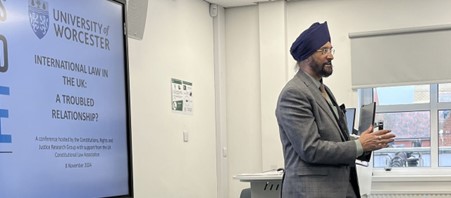
Image: Prof. Satvinder Juss delivering the keynote, International Law & the Rwanda Judgment: Problems & Prospects.
The fascinating papers, presented across the five conference panels, were a testament to the quality and breadth of scholarly work on the UK and international law.
There were several important contributions on the theme of dualism. As reiterated by the UKSC (notably in R (Miller) v Secretary of State for Exiting the European Union) the UK is understood as a dualist system whereby international and domestic law are separate systems. Yet, as many of the papers revealed, it is debatable to what extent this is accurate (or desirable). In their paper, The Dissolution of Dualism, Prof. Roger Masterman (Durham) and Dr Matthew Nicholson (Durham) suggested that whilst the concept continues to be influential, it provides an ‘incomplete picture of the relationship between the UK domestic and international legal orders’. Dr Lewis Graham (Cambridge) nevertheless argued that the UKSC has shown a ‘general trend toward judicial conservativism’, and that this has led the court to adopt a rigid view of dualism.
Dr Joanna Bell (Oxford) drew on various cases, notably EOG v Secretary of State for the Home Department, to identify the emergence of a ‘new iteration of judicial review’ whereby courts can properly review the lawfulness of government guidance against unincorporated treaties. Yet, Gabriel Tan (City Law School) and Dane Luo (Oxford), in their paper, considered that this approach is inconsistent with parliamentary sovereignty and dualism and that the common law ‘must develop a restraint such that it does not violate’ these principles. Finally, in their paper Can the Crown now authorise terror?, Dr Tristan Webb (Aberystwyth) drew on the work of J. G. Starke to revisit the original meaning of dualism and monism. Webb argued that whilst parliament is sovereign, its supremacy ‘is only because of the involvement of the Crown’s prerogative’, which cannot act outside of the law.
Human rights also received considerable attention at the conference. The ratification of international human rights treaties by the UK and incorporation of the ECHR means that public bodies, not least the courts, are routinely engaging with international human rights law. Dr Christine Bicknell’s (Exeter) paper discussed whether the UK’s rejection of various international human rights norms in recent years weakens the UK’s status as a liberal democracy. Acknowledging that it probably does not, the disjunction between the promise and practice of liberal democracy was underscored, and an argument made for an inclusive and more encompassing approach to rights. Jobair Alam (Staffordshire) further interrogated the UK’s relationship with international refugee law, highlighting that whilst the UK’s migration policies have historically drawn heavily on international standards, the recent MEDP with Rwanda showed a distinct lack of care for the UK’s obligations. Dr Stuart Wallace’s (Leeds) paper revealed the ‘Lifecycle’ of declarations of incompatibility, issued by ministers under s 19 of the Human Rights Act 1998. Wallace argued that Parliament is often ‘squeezed out of the process of protecting rights’ due to optimistic, executive-driven assessments, and an ignorance towards the views of Parliament’s Joint Committee of Human Rights. Lastly, Kelly Rowney (University of Law) revisited the question of whether the ECHR has limited parliamentary sovereignty. Drawing on similar concerns which led the UK to leave the European Union, Rowney argued that whilst the ECHR does place limits on parliamentary sovereignty, these are not in themselves a justification for the UK leaving the Convention.
The conference also provided an important devolved perspective. In view of the increasing alignment of law and policy with international law in Wales and Scotland, these papers highlighted the challenges and opportunities for these regions. Sara Moran drew on her expertise as the Senior Research Officer for International Affairs at the Senedd. Moran’s paper set out the role of the UK’s international obligations for Welsh ministers, noting in particular the Senedd’s innovative treaty scrutiny process. Dr Erin Ferguson’s (Aberdeen) paper argued that the UK Supreme Court’s decision on the Scottish Parliament’s UNCRC Bill adopted an ‘expansive approach’ to the interpretation of s 28(7) of the Scotland Act 1998. This, Ferguson observed, ‘places additional limits on the Scottish Parliament’s legislative power’.
Finally, three papers looked at how the UK commits itself to international instruments and its broader compliance with its international obligations. These contributions fed into wider debates surrounding the UK’s commitment to the international rule of law in recent years. Notably, in a 2023 report, the House of Lords Constitution Committee expressed its ‘disquiet about the constitutional desirability of Parliament legislating in violation of the UK’s international obligations’. In The Law of Treaty Withdrawal, Dr Frederick Cowell (Birkbeck) examined an overlooked aspect of the treaty-making process, namely the means of withdrawal. Here, Cowell highlighted the minimal domestic, democratic controls over treaty withdrawal and the particular issues that have arisen for devolved parliaments. Dr Chris Monaghan’s (Worcester) paper, As British as Fish and Chips?, drew on case studies, including the ongoing dispute over the Chagos Island, the aforementioned MEDP with Rwanda, and the original version of the UK Internal Market Act, finding that the UK has frequently ‘thumb[ed] its nose to the international community’ and damaged its reputation for upholding the (international) rule of law. Nina Hart (King’s) analysed the UK’s unilateral sanctions regime and its compliance with international law. Hart showed that since Brexit and the passage of the Sanctions and Anti-Money Laundering Act 2018, the UK’s sanctions show significant alignment with US policies.
The conference set out to tackle the question, ‘International Law in the United Kingdom: A Troubled Relationship’? Upon reflection, ‘troubled’ would be misleading. In fact, the conference provided a more optimistic picture than some might have expected, revealing a positive but nevertheless complex and at times difficult relationship. International law has provided actors in the UK with opportunities to strengthen accountability and to uphold human rights and democracy. It has also acted as an important framework to ensure that on the international plane, the UK and other states tackle systematic, global issues in a careful, considered manner. There are nevertheless challenges that require ongoing scholarly inquiry. These include, not least, how courts can and should engage with international law, and how best to ensure the democratic oversight of treaty-making (and unmaking).
Dr Michael Lane, Lecturer in Law, University of Worcester
Lily Brown-Goode, LLB Law Student, University of Worcester
 UK Constitutional Law Association